
Bookbinding
Creation of Bindings, from Simple to Elaborate
Whether made of paper, cloth, parchment, or leather, and with corners, raised bands, tinted or marbled papers, the workshop creates numerous types of bindings not only to protect but also enhance the textblocks.
We make many models, from the more common structure to the most elaborate and fine quality binding.
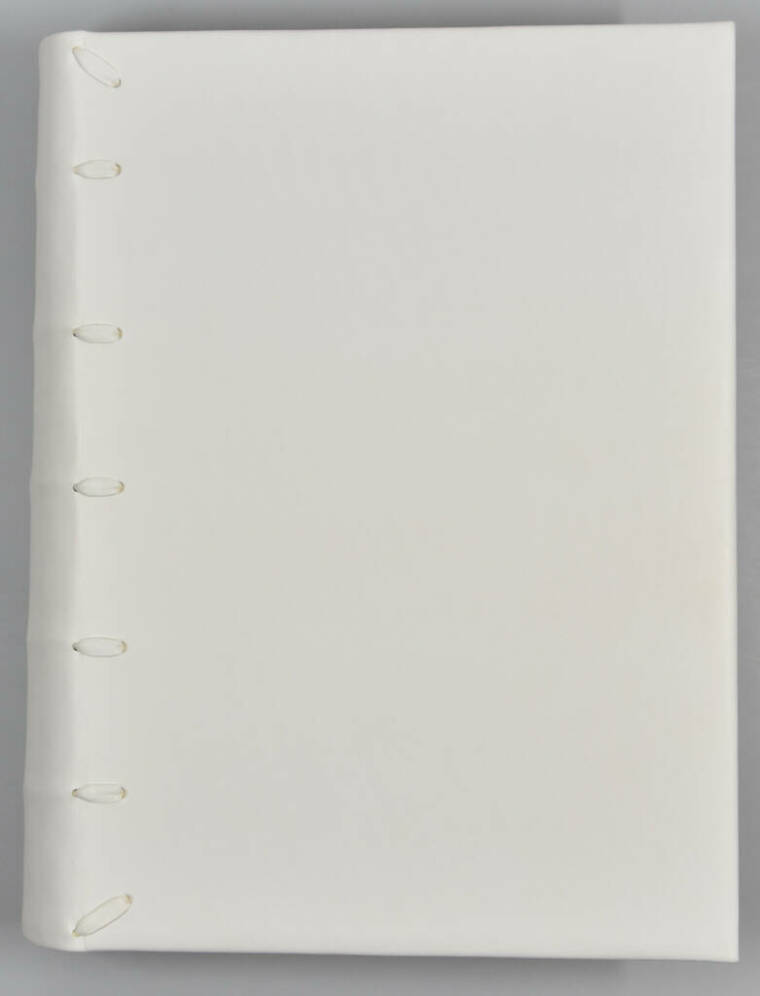

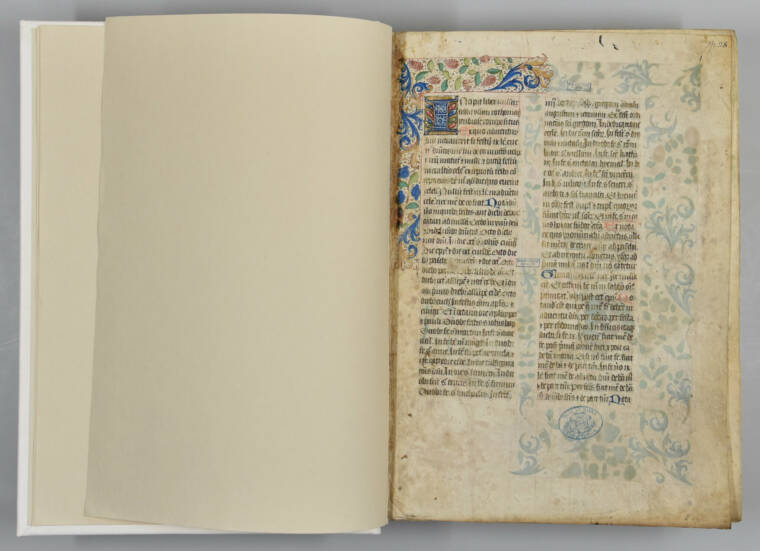
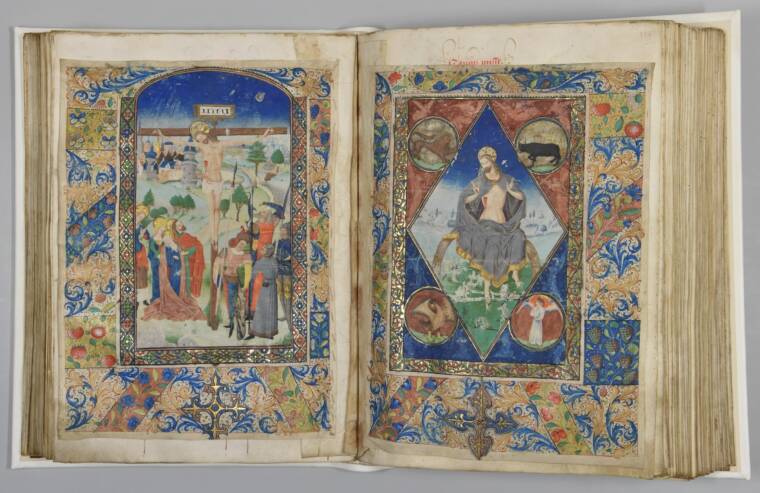
Conservation Binding in Full Alum-Tawed Skin, Liber missarum secundum usum Rothomagensem studiose compositus, ca. 1450
Municipal Library, Havre (2022)
Conservation Binding in full Alum-Tawed Skin
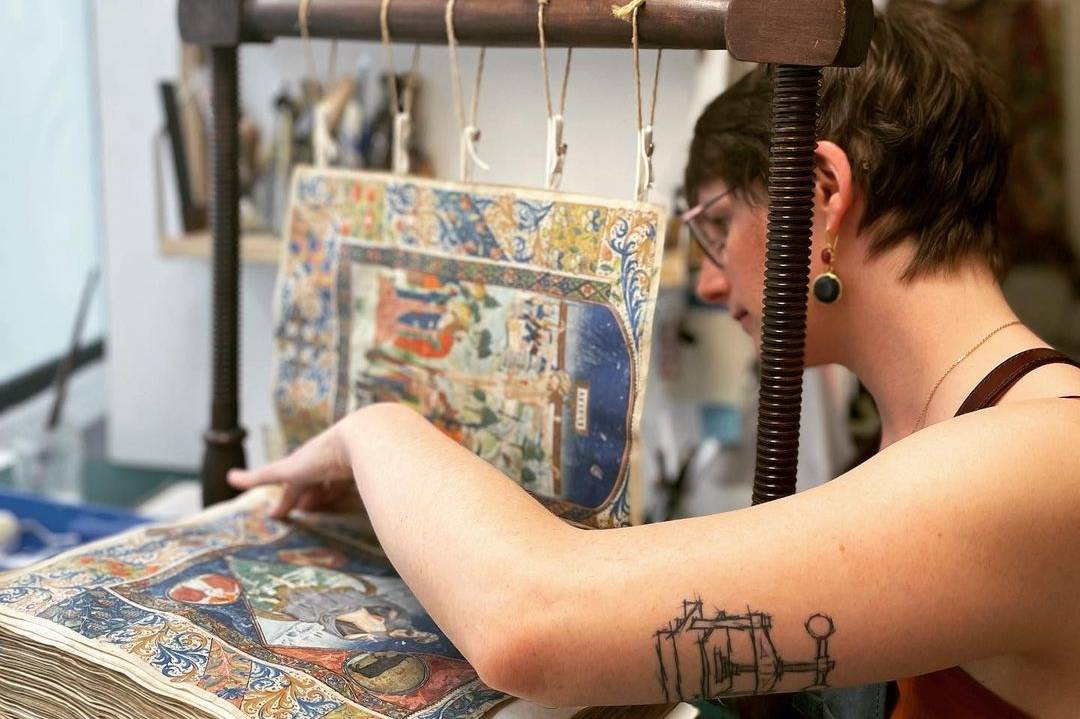
Missal for the Use of Rouen
Identification
Reference Number: Ms325
Title: Liber missarum secundum usum rothomagensem studiose compositus
Date: 1450
Dimensions: 39 x 30 x 10 cm
Previous Binding: Full sheepskin leather, 19th century
Sewing Type: Sewn on five raised cords
Medium: 317 parchment leaves
Technique: Manuscript ink, illuminated initials
Illustrations: Two full-page miniatures
Detail
This missal for the use of Rouen contains all the liturgical offices as they were celebrated in the church of Rouen in the 15th century, with prayers specific to this diocese.
It was rebound in the 19th century in a low-quality brown calfskin binding, whose boards had detached. Due to the significant degradation of this binding, it was decided to replace it with a “conservation binding.” The covering material and hinges are made of alum-tawed skin, and the sewing was done on six single strips cut from the same material. In addition to the durability provided by the alum-tawed skin, this type of binding minimises the use of adhesives and combines openability with mechanical strength.
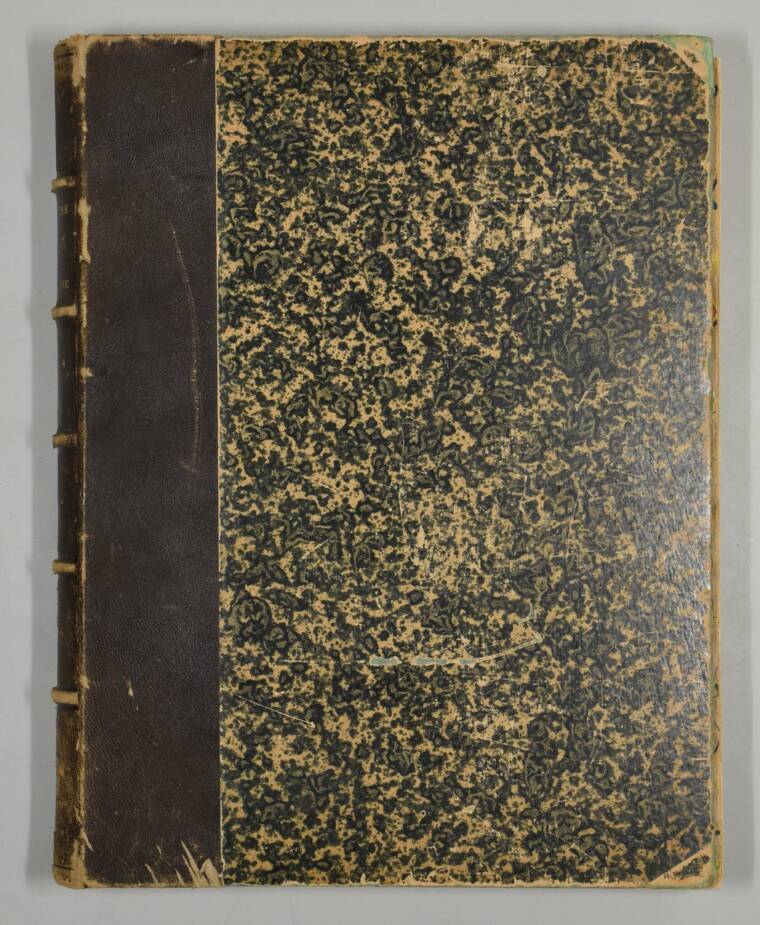
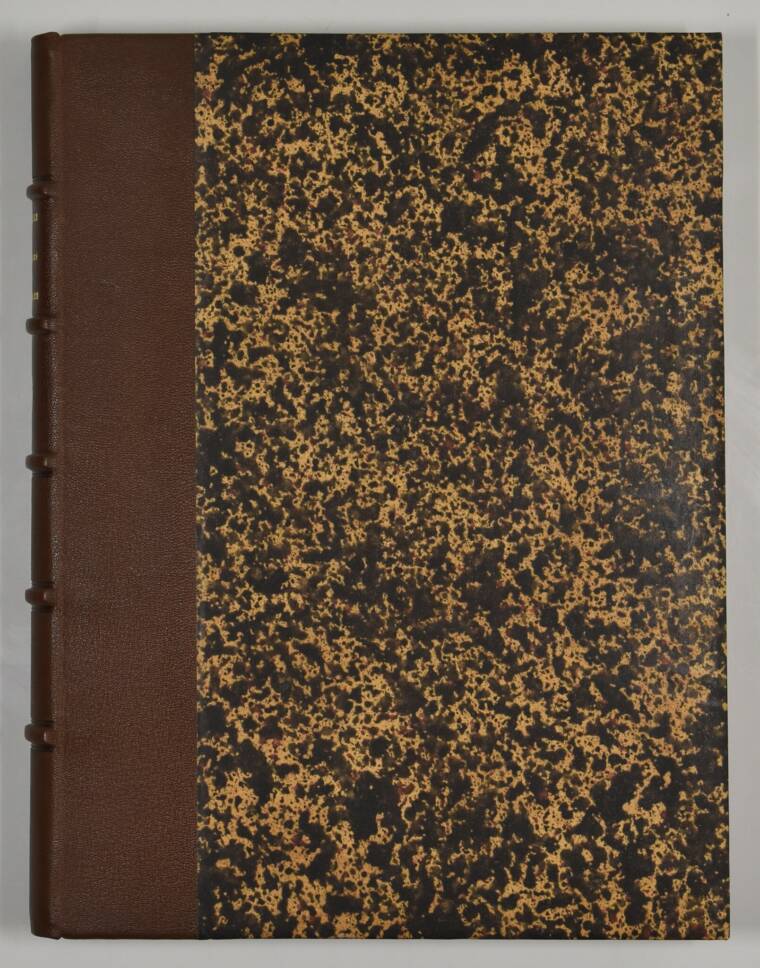
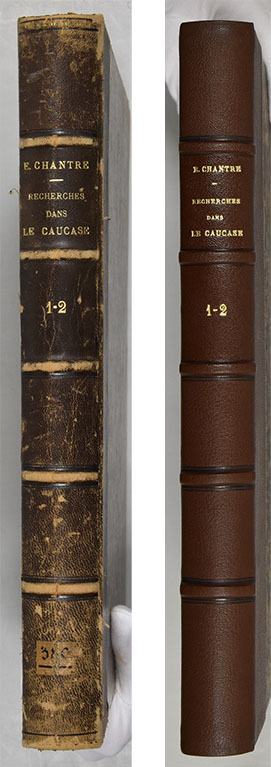
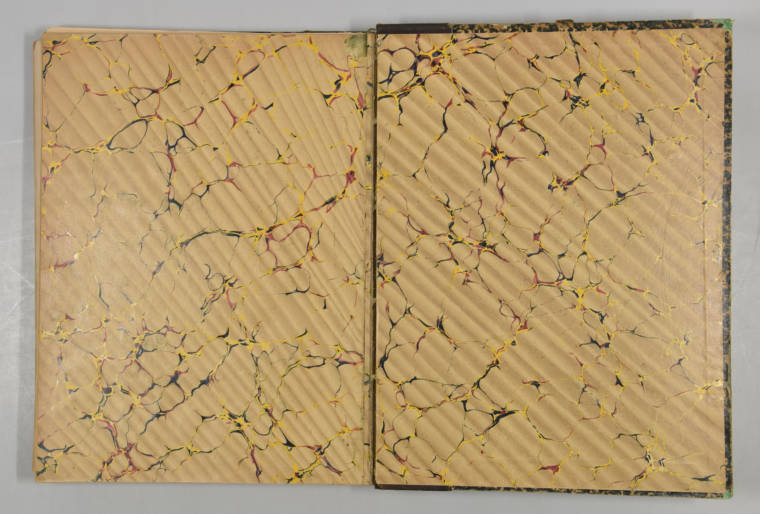
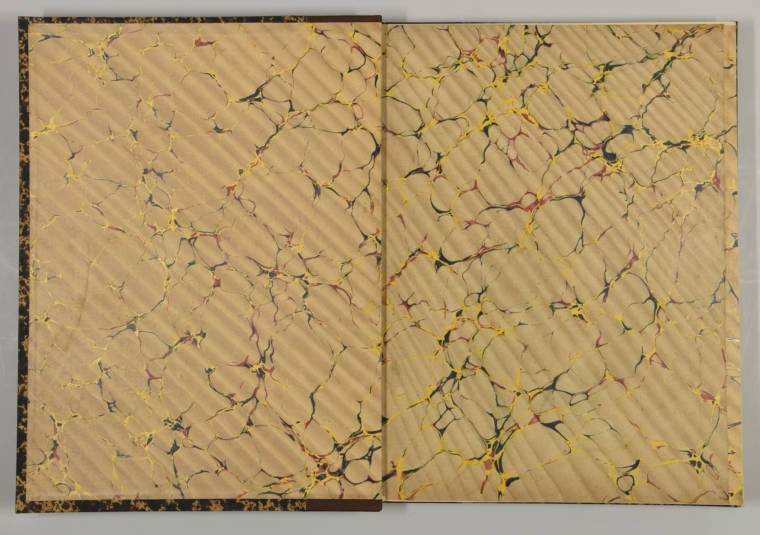
Half-Leather Binding with Annonay Paper Boards, Ernest Chantre, Recherches dans le Caucase, Volumes 1 and 2, 1885
National Archaeology Museum, Saint-Germain-en-Laye (2021)
Half-Leather Binding with Annonay Paper Boards
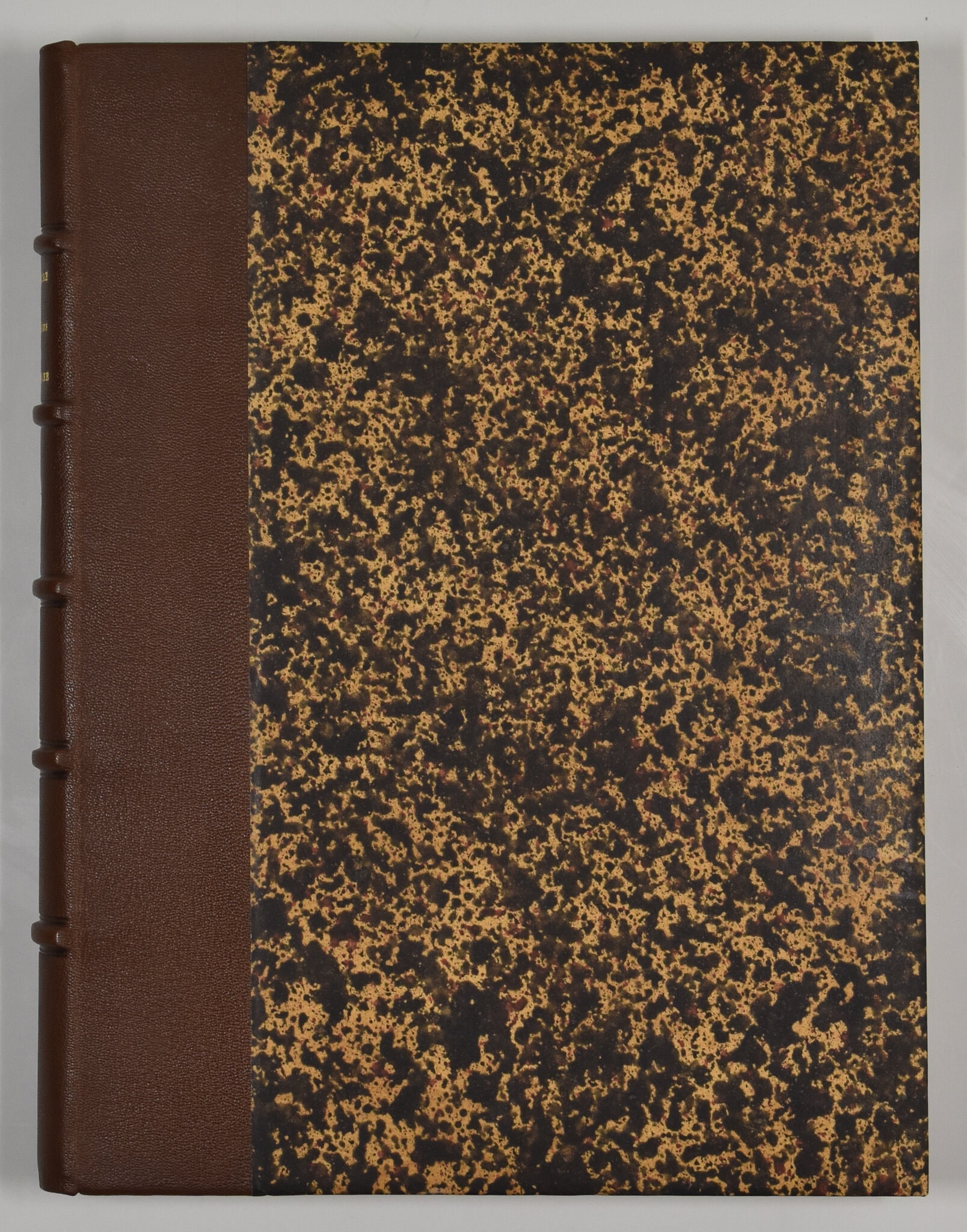
Recherches dans le Caucase, Tomes 1 à 4
Identification
Author: Ernest ChantreTitle: Recherches dans le Caucase, Volumes 1 to 4
Publisher: Charles Reinwald
Place of Printing: Paris
Date: 1885
Dimensions: 36.7 x 28.5 x 4 cm
Binding Type: Half brown morocco. Annonay-style marbled paper on the sides. Corners covered in green parchment.
Textblock: Typographic printing on wove paper
Detail
Anthropologist specialising in the Caucasus, Armenia, and Anatolia, Ernest Chantre (1843-1924) conducted several missions in the Caucasus and published his Recherches dans le Caucase in 1885.
This set of four volumes underwent treatments specific to the condition of each volume. Volumes I and II were recreated identically, while Volumes III and IV, which were in a fair condition for access, were consolidated as they were. The manufacture of marbled papers was entrusted to Marianne Peter to reproduce the same pattern as the original.
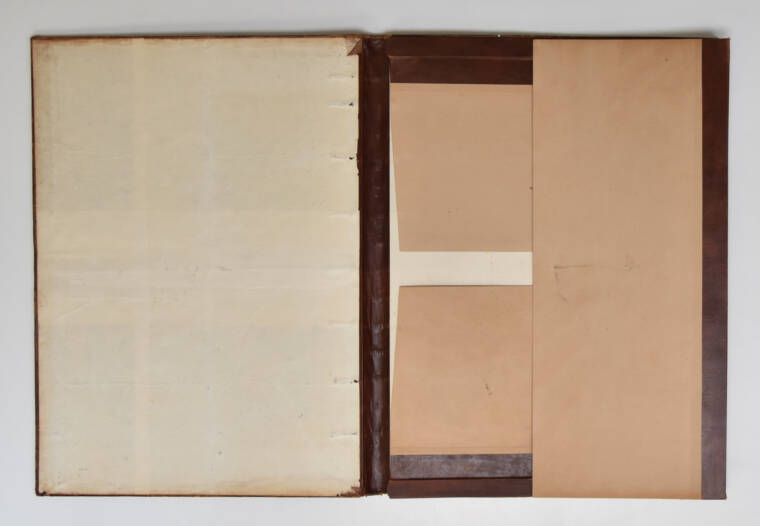
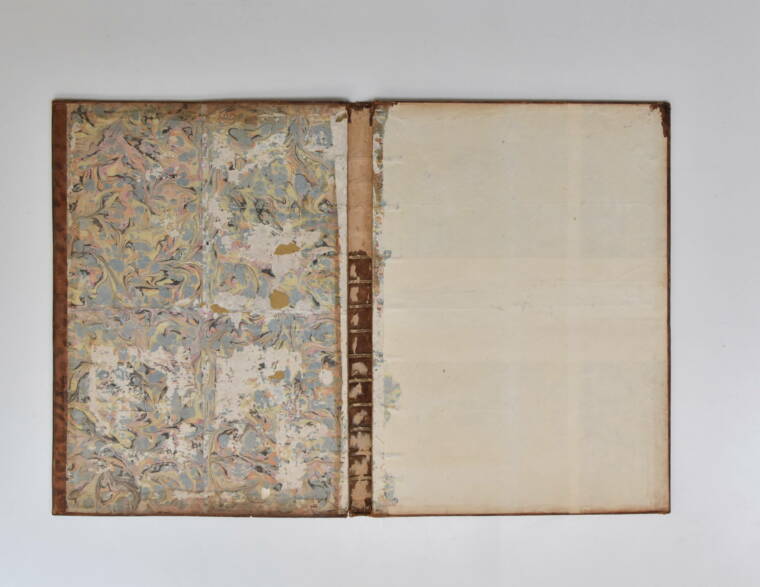
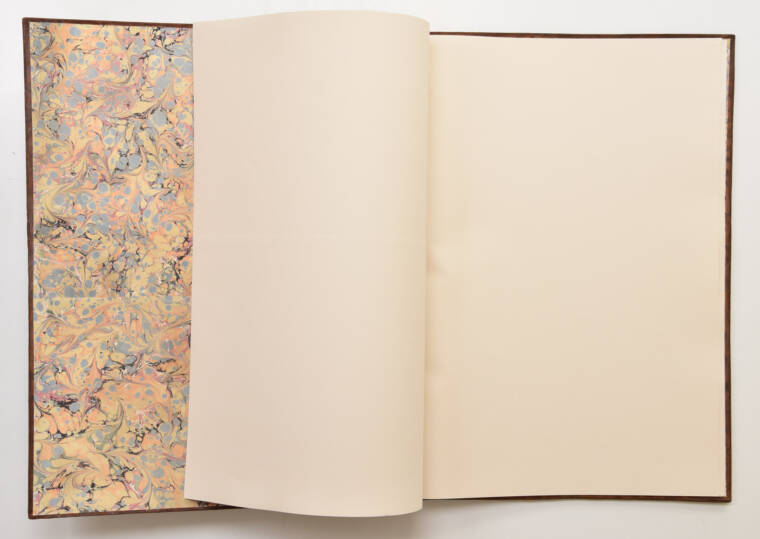
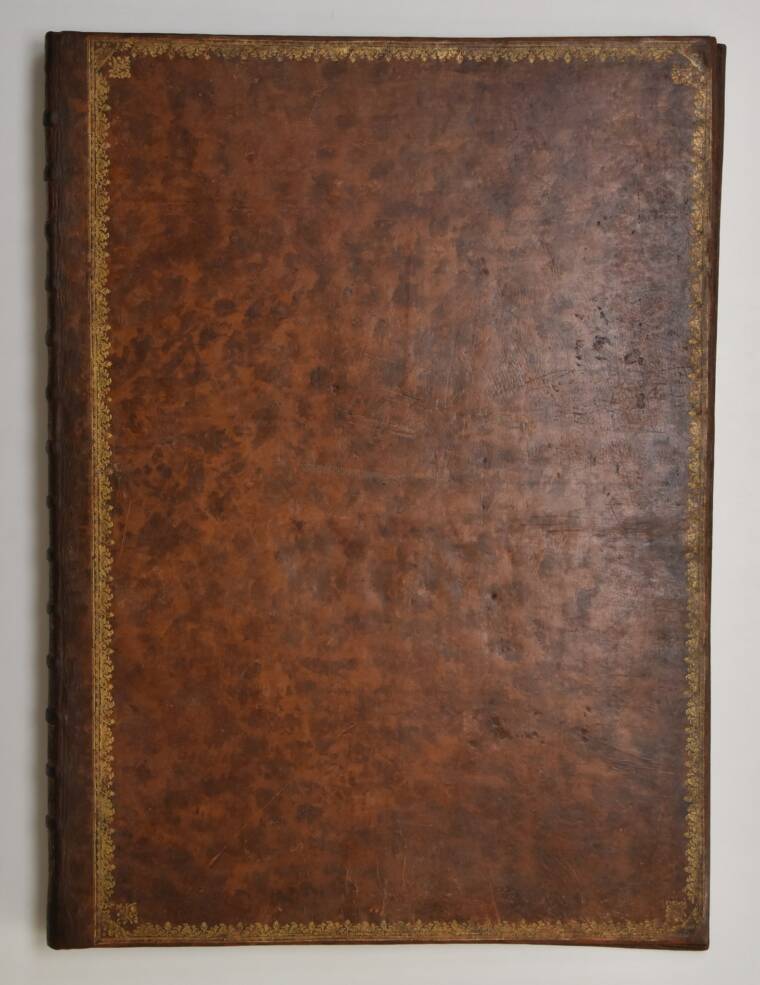
Transformation of a Portfolio into an Album to Preserve Drawings
Custodia Foundation, Paris (2022)
Transformation of a Portfolio into an Album to Preserve Drawings
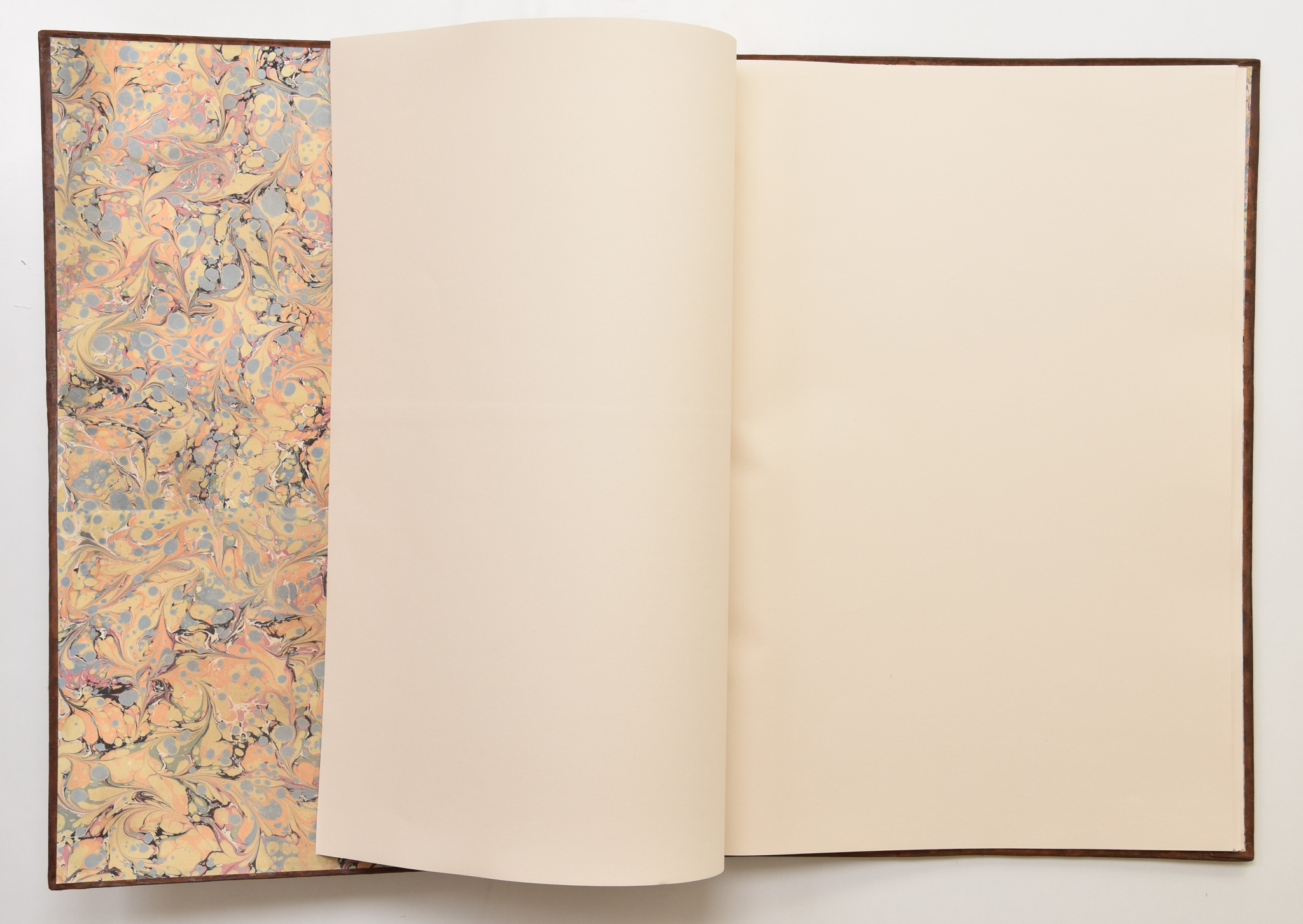
Porte-folio / Album
Identification
Reference Number: 2020-R.2
Document Type: Portfolio intended to preserve drawings
Date: 18th century (boards and cover)
Binding Type: Full tree-calf leather
Decoration: Framed with a gold-tooled roll and corner fleurons on the boards. Panels decorated with floral fleurons and gold lines. Red leather title label with gold titling.
Dimensions: 96 x 71 x 5 cm
Feature: This portfolio was originally an album, which was transformed into a portfolio during the 20th century.
Detail
The workshop has been collaborating with the Custodia Foundation since 2017 on the ongoing conservation project of its albums of drawings.
Frits Lugt, founder of the Custodia Foundation, gathered a collection of old drawings and prints dating from the 15th to the 19th century. To ensure their preservation, he chose to insert them into albums with blank leaves, as was customary until the 18th century.
In continuation with the conservation approach of its founder, the Foundation entrusted us with the adaptation of some of their old portfolios to transform them into albums containing new paper designed to house new acquisitions.
The manufacture of the blank paper sheets was entrusted to Gangolf Ulbricht, and that of the marbled paper used for endleaves to Marianne Peter.
For more information, see the videos on the homepages of our website and of the Custodia Foundation. You can also read more about the project in the article published in Arts et Métiers du Livre, “Les Albums de la Fondation Custodia, une restauration exemplaire,” No. 344, 2021, pp. 28-33.
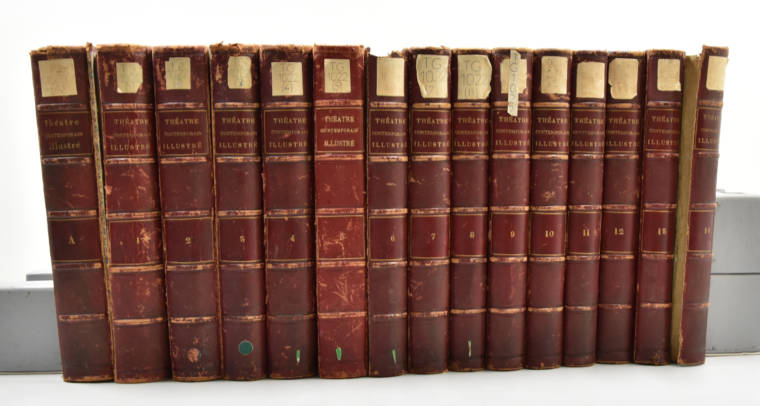
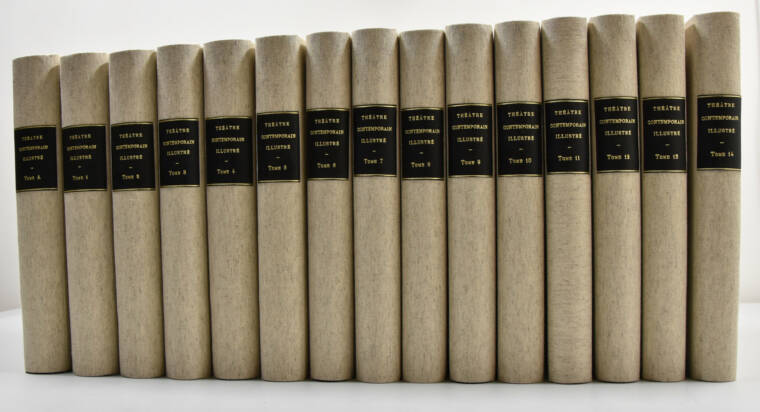
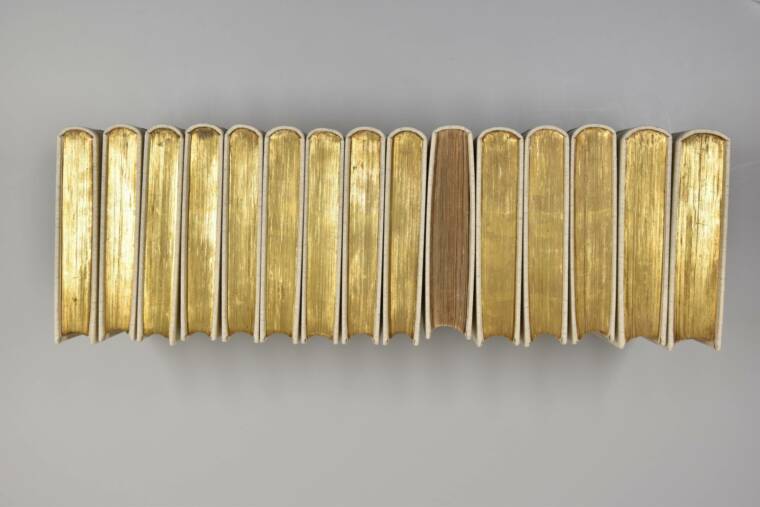
Full Cloth Bindings of Théâtre contemporain illustré
Gaston-Baty Theater Library, Paris (2020)
Full Cloth Bindings of Théâtre contemporain illustré
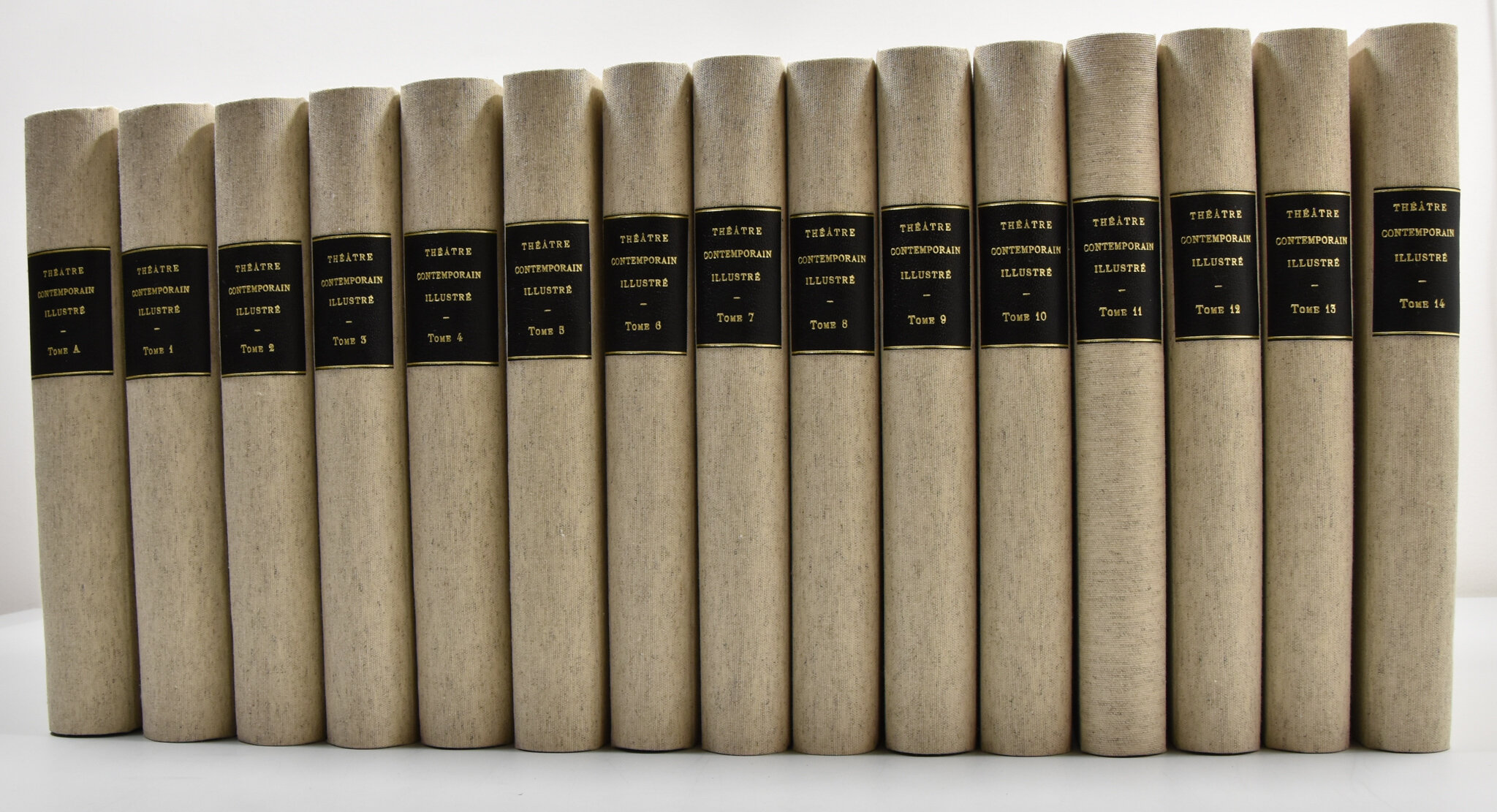
Théâtre contemporain illustré
Identification
Reference Number: TG 1022 (1-14) (A)
Title: Théâtre contemporain illustré (15 vols.)
Date: 19th century
Publisher: Michel Lévy, Paris
Binding Type: Half maroon leather
Dimensions: Approximately 31 x 23 x 5 cm
Detail
A series of fifteen volumes of the Théâtre contemporain illustré, a journal specialising in 19th-century theatre, showed advanced degradation, indicative of its intensive use. No specific provenance or ownership marks were noted.
Due to their unrestricted access, it was decided to create new durable bindings in full mixed canvas and spine labels made of leather labels for the titles and volume numbers.